Intelligence lab / Migration
Knowledge migration audit
Validate a metadata-only document manifest before rebuilding a bot. Flag duplicate IDs, drafts, retired content and documents marked for review; do not transfer the document contents here.
Fixture 2026-11-26-v1 · PIP research · no live vendor measurements.
Interactive · browser-only
Work with your own assumptions
Choose a worked example or enter your own non-identifying assumptions, then run the calculation.
Local only. Use non-identifying inputs, never customer data or credentials. Downloads stay on your device.
Illustrative example result · not measured vendor performance
Knowledge manifest audit
Remove obsolete/duplicate entries or resolve review status before import.
Scroll the result table sideways on smaller screens if needed.
| ID | Versions / status | Import manifest decision |
|---|---|---|
| returns-policy | v2 approved; v1 retired | Resolve versions/status |
| shipping-policy | v1 approved | Ready metadata |
| pricing | v1 review | Resolve versions/status |
Interpretation and limitations
- A retired record can be kept in a separate archive, but not in this current import manifest. A version number alone does not establish truth; compare approved content before ingestion.
Take the result with you
Download the current scenario report as JSON. The report includes inputs and limitations, not a certification.
Why this matters
Practical situation
A migration team exports every page, including obsolete policy versions. The new chatbot learns old and current material together and returns contradictory answers.
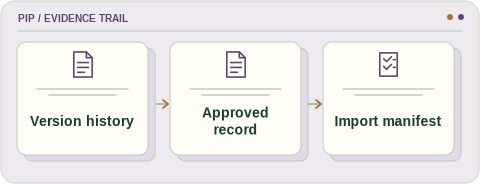
Research workflow; use the tool for actual inputs.
Reproducible method
Work through the test
Illustrative methodology; test real configurations only with authorisation.
Make this useful in practice
What to do next
Review approved document contents, retain history in a separate archive and run grounding tests after ingestion.
Evidence and boundaries
Sources and scope
- PIP original deterministic fixture v1 · 2026-11-26
Examples and outcomes here are computed from explicit assumptions or user-supplied observations. Do not treat them as a certification, competitor measurement, real booking or guaranteed commercial result. No confidential records or third-party access are required.