Research library / Installation & diagnostics
Train an AI chatbot on website content: sources, refreshes and answer quality
Start with a small approved collection of authoritative pages, record their ownership and refresh rules, and test the chatbot against expected answers. Adding more URLs is not a substitute for an accurate knowledge base.
Editorial review: 2026-11-27 · OWASP: prompt injection · PIP research, not a live vendor performance test.
Decision path
Work through the problem
Practical example
A common situation
A fictional catering business publishes a £25 minimum spend on its old menu and £35 on its current booking page. The operator marks the current policy as authoritative, removes or labels the stale document and tests a quote request before and after the refresh. Passing means the correct current minimum is used, not simply that both pages were fetched.
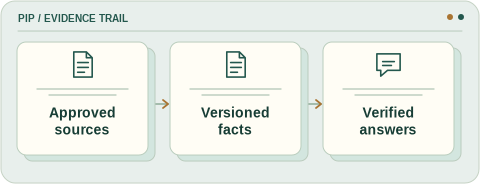
Illustrative decision workflow, not measured product performance.
Implementation guide
Where to go and what to check
Start here: Approved source inventory → crawl and normalisation → versioned knowledge → evaluation.
- Inventory URLs, documents, title, owner and effective date. Exclude checkout, private accounts, thin duplicates and unapproved third-party content. Separate authoritative commercial rules from marketing examples.
- Construct an expected-answer sheet with ten common customer questions, three changed facts, two conflicts and five out-of-scope questions. Include the exact supporting passage, not a paraphrase generated by the bot.
- Refresh in a controlled environment and inspect the new source version, successful fetch status, parsed text and retrieval for changed facts. Keep the prior validated version available for rollback.
- Run the same cases before and after deployment; review answer text and source evidence. Do not mark the refresh complete based on a crawl summary alone.
What a passing test looks like
Current authoritative fact wins over the obsolete copy
Unknown and conflicting evidence produce an appropriate cautious response
Refresh error leaves the previous approved knowledge available
Interactive troubleshooting
What are you seeing?
Recommended next check
Check source timestamps, duplicate chunks and refresh receipts; remove stale authority.
See all diagnostic paths
- Answers use an outdated price
- Check source timestamps, duplicate chunks and refresh receipts; remove stale authority.
- The bot invents a policy
- Require an answer grounded in approved facts or an explicit unknown and human fallback.
- A public page contains misleading instructions
- Treat page text as data rather than privileged instructions; isolate and inspect suspicious content.
This is a diagnostic guide, not a test of your website. Verify actual configuration before changing it.
Verification checklist
Before you call this complete
Checklist state is local to this page and is not submitted or stored.
Practical questions
Frequently asked questions
Can I train a bot on every page of my website?
Only ingest content relevant to its job and permitted for its audience. Start with high-value pages and test quality before expanding.
Is crawling the same as model training?
Often no: website-based chatbots may retrieve indexed content at answer time rather than changing model weights. Ask the provider how its system works.
How often should I refresh?
Match the cadence to how often facts change, and test after material updates. A daily schedule alone is not evidence of a successful refresh.
Evidence and limitations
Primary sources
- OWASP: prompt injection — checked 2026-11-27
- OWASP: sensitive information disclosure — checked 2026-11-27
Vendor documentation and browser guidance informed the steps. Scenarios are illustrative; we have not accessed your installation. Preserve your site’s security and consent requirements.