Faulty implementation
Fail- 1. document-load
- 1
- 2. route-change
- 2
- 3. route-change
- 3
- 4. route-change
- 4
- 5. route-change
- 5
- 6. document-load
- 6
Intelligence lab / Failure atlas
Replay a synthetic document-load and client-route sequence. Compare a loader bound to every route change with an idempotent once-per-document guard.
Fixture 2026-11-26-v1 · PIP research · no live vendor measurements.
Interactive · browser-only
Choose an example to compare two implementations, or change the inputs and run again.
Local only. Use non-identifying inputs, never customer data or credentials. Downloads stay on your device.
Illustrative example result · not measured vendor performance
Two actual document loads are simulated. Client navigation must not initialise a second widget within the same document.
Scroll the result table sideways on smaller screens if needed.
| Observable check | Faulty implementation | Repaired implementation |
|---|---|---|
| 1. document-load | 1 | 1 |
| 2. route-change | 2 | 1 |
| 3. route-change | 3 | 1 |
| 4. route-change | 4 | 1 |
| 5. route-change | 5 | 1 |
| 6. document-load | 6 | 2 |
Download the current experiment report as JSON. The report includes inputs and limitations, not a certification.
Why this matters
A single-page app navigates without a full document reload. Repeated initialisation may create duplicate requests or handlers, even though only one widget should be active.
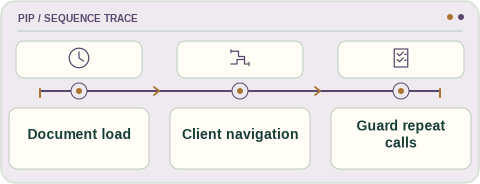
Conceptual fixture; test actual behaviour in the workbench.
Reproducible method
Illustrative methodology; test real configurations only with authorisation.
Make this useful in practice
Inspect actual requests, listeners and widget instances. A once-per-document guard also needs a documented teardown and reinitialisation strategy.
Evidence and boundaries
Examples and outcomes here are computed from explicit assumptions or user-supplied observations. Do not treat them as a certification, competitor measurement, real booking or guaranteed commercial result. No confidential records or third-party access are required.